Ever tell yourself, “Just one more” and then watch your savings take a hit? Carnival season can do that, whether you are playing mas, going to a fete, heading to the beach, doing a river lime, or using the long weekend for family time or a staycation. Not everyone takes part, but the spending energy is everywhere. If you are saving for a deposit, it helps to have a plan that lets you enjoy the season without losing momentum. This T&T Carnival budget guide uses a simple 3-bucket plan and a 24-hour rule to avoid impulse spending.
Carnival Fetes
Carnival fact: The UWI Fete is often credited as the first public all-inclusive fete in Trinidad and Tobago, and the contribution for admission was $100.
A fete is rarely the one big expense. It is the extras that trail behind it. You sort out tickets, then somebody adds an after-party stop for food, and suddenly you are spending on the fly. The fix is not to turn into a hermit for six weeks. The fix is to decide, in advance, what your money is allowed to do this season.
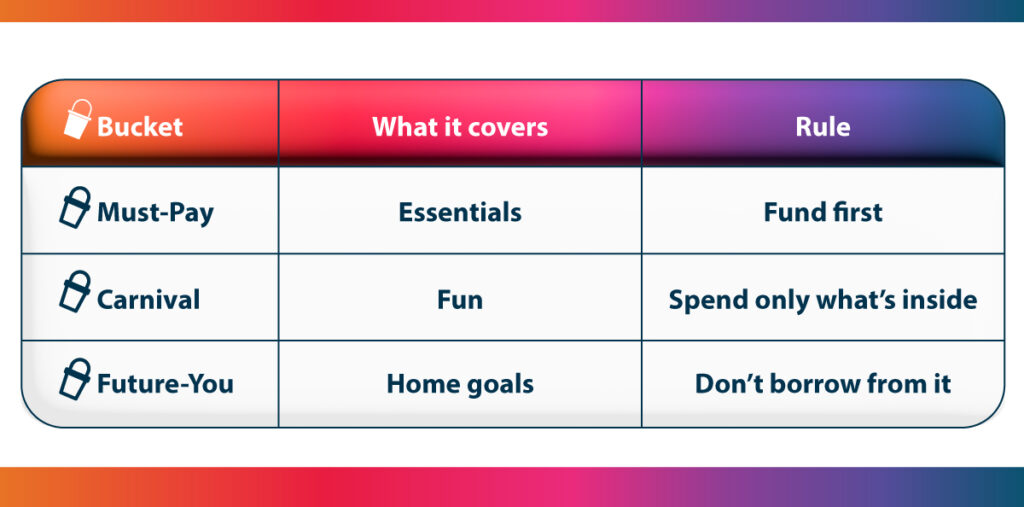
That is where the three buckets come in. Keep them simple, keep them visible, and you stop negotiating with yourself every weekend.
- Must-Pay: essentials that keep your month steady
- Carnival: planned fun spending
- Future-You: the deposit, a small emergency buffer, and home-related savings
Panorama
Carnival fact: Jit Samaroo won Panorama three years in a row with Renegades: 1995, 1996 and 1997.
Panorama is a good reminder that discipline is your friend. The song is drilled for hours, so that all parts of the arrangement can be heard and a 120-person orchestra comes together as one. That is the job of your Must-Pay bucket.
“Must-Pay” is the money that covers what keeps your month stable through discipline: rent, groceries, utilities, transport to work, loan payments, family support. When those are funded first, you do not have to spend with a quiet worry in the background. You can still enjoy yourself, but you are not putting off bills.
Fund “Must-Pay” first. Then decide what percentage of your monthly income you can put toward Carnival. After that, send something to “Future-You” automatically, even if it starts at 5 percent. The point is not the number. The point is that “Future-You” gets paid consistently.
Dimanche Gras
Carnival fact: The first National King of Carnival competition was staged in 1963, and it was won by Colin Edghill portraying Henry VIII, from Archie Yee Foon’s “The Field of the Cloth of Gold.”
Dimanche Gras is not thrown together. It is planned, paced, and rehearsed. Your Carnival bucket works the same way. It is not a vague hope. It is a plan you can live with.
Set your Carnival bucket based on what you already know about yourself. If you tend to get caught by last-minute plans, build a small “flex” amount inside the bucket so one unexpected lime does not derail you. If you prefer fewer events, decide your one or two “big spend” moments and make peace with skipping the rest.
Also, remember that Carnival spending is not only fetes and costumes. Some people spend on a beach day, extra groceries for family, a quick Tobago run with a visiting friend, or a short staycation. Those still count as Carnival spending. Once they sit inside the Carnival bucket, you can enjoy them without pulling from Must-Pay or Future-You.
Carnival Monday and Tuesday
Carnival fact: In 1972, Carnival was postponed from February to May because of the threat of polio, the “Mas in May” many people still talk about.
Carnival timing can change. Your goals still need a steady plan. This is where the 24-hour rule helps. If a spend was not planned and it is not “Must-Pay”, sleep on it.
Here is the process:
- Pause
- Sleep on it (wait 24 hours)
- Check the Carnival bucket
- Decide guilt-free
A day gives you space to separate “I want it now” from “I still want it, and it fits my plan.” If it fits, you can say yes without stress. If it does not, you are not missing out. You are choosing not to deprive “Future-You”.
A few guardrails help the rule work during the busiest days. Decide your daily cap before you leave home. Sort transport early where you can. Eat first so “small snacks” do not turn into a full extra bill. If tapping your card makes you lose track, lower your card limit for the week or carry cash for small spends. And if you have someone you trust, make them your “sleep on it” check buddy.
The goal is not to say no. It is to say yes on purpose.
Last Lap
Carnival fact: The Trinidad Guardian organised the first Carnival competition at the Queen’s Park Savannah in 1919, partly to commemorate the end of World War I.
Last Lap energy is real. It is also when a lot of budgets get flung aside because it feels like the last chance. Dedicate some time after the party to check in on “Future-You”:
- Review what you spent and where it went
- Refill “Future-You” first, even if it is a small top-up
- Restart your automatic savings transfer
- Adjust next month based on what worked
If buying a home is part of your 2026 plan, it helps to know what “on track” looks like in numbers. TTMB’s Mortgage Calculator can help you turn “Future-You” into a monthly target you can work with.
Your Carnival can be full and still fit inside your bigger plans. The 3 buckets keep Must-Pay steady, keep Carnival spending honest, and keep Future-You funded. The 24-hour rule gives you space when impulse spending shows up. The reset helps you get back to normal without beating up on yourself. Start where you are and keep it simple. Own your future.
Next steps
You might also enjoy:
- Fete Smart, Save Smarter: A Carnival Guide to Balancing Fun and Finances
- From Fetes to Finances: Your Comprehensive Post-Carnival Reset Guide
- Your Path to Homeownership: Build Financial Readiness and Own Your Future